


There are several astronomical filter manufacturers in the world. One of the leaders is definitely Optolong, their excellent price-performance ratio filters are well known in the market. The company has been approaching me for years with a new model, asking if I would like to take photos with them, either before or in parallel with their release. Since these filters are usually of interest from a professional perspective, I usually undertake these tasks. That’s what I did this time too. I’m not doing a comprehensive test, several influencers have already done that. But I’m happy to show you a thoroughly photographed image, and I’ll also show you the raw and the summarized ones.
About the Heart Nebula in general
The Heart Nebula (IC 1805 or Sh2-190), which also includes NGC 896, is not a single gas cloud, but a gigantic H-II region consisting of many smaller, independently cataloged objects. It is located in the constellation Cassiopeia and is part of the Perseus spiral arm of the Milky Way. The nebula’s reddish color is caused by the radiation of ionized hydrogen gas (H-II), which is excited by the intense ultraviolet radiation of nearby, young, hot stars. The object is about 7,500 light-years from Earth and is vast, more than 300 light-years in diameter. The nebula’s shape and structure are shaped by stellar winds and radiation from the hot stars within it.
The main subject of the image: NGC 896
NGC 896 is the western, brightest part of the Heart Nebula. It is also often called the Fishhead Nebula and has the catalog number IC 1795. It was discovered by William Herschel in 1787, and as the first object in the Heart Nebula complex to be identified, it has been given a special place in the New General Catalogue (NGC). NGC 896 is an emission nebula, meaning that it emits its own light because the atoms in the gas within it are in an excited state. The region of NGC 896 is the site of intense star formation activity. The nebula is being fed by extremely hot, young, massive O and B-type stars in the nearby star cluster Melotte 15 (also known as Collinder 26 or IC 1805). These stars are only 1.5 million years old and may have masses up to 50 times those of the Sun. The intense ultraviolet radiation from them ionizes hydrogen and other gases (such as oxygen and sulfur), giving the nebula its characteristic red and blue glow. The Fishhead Nebula contrasts sharply with the darker dust clouds that also form part of the region. The most prominent of these is…
LDN 1359
LDN 1359 is a dark nebula. LDN is an abbreviation for Lynds’ Dark Nebulae Catalogue, compiled by American astronomer Beverly T. Lynds in the 1960s. Dark nebulae are dense, cold, dusty interstellar clouds that absorb or block light from sources behind them. LDN 1359 is one such absorption nebula, forming a distinct, dark patch against the background of bright emission nebulae. Dark nebulae contain carbon monoxide, molecular hydrogen, and other complex molecules that provide ideal conditions for the formation of new stars. The visual appearance of LDN 1359 is key to understanding the wider Heart Nebula complex, as it highlights the channels of dust and gas from which future stars may form.
NGC 896 is a resident of the constellation Cassiopeia. Look for it to the left of the “W”, almost as if you were drawing another stem to the existing shape, closed at a similar angle to the previous ones.

The photo was taken in September 2025. This period was characterized by variable seeing, but good transparency. To create the image, in addition to the aforementioned, newly arrived L-Synergy filter, I used Optolong’s long-standing counterpart, the L-eXtreme filter. Both products were offered by the manufacturer, for which I would like to thank them.

Optolong L-Synergy 2″ is a 7 nm narrowband dual filter designed for nebular astrophotography with color cameras (DSLR, CMOS and CCD). It transmits only the emission lines of Oxygen III (500.7 nm) and Sulfur II (672.4 nm), effectively blocking light pollution and increasing the contrast of the sky background. It provides more than 85% transmission even in fast telescopes starting at f/3.3 aperture. It allows Hubble Palette images without a monochrome camera or a full set of three filters. Let’s take a quick look at the well known L-eXtreme filter too: also a 7 nm bandpass filter, but this model transmits the emission lines of Hydrogen and Oxygen III nebulae.

So it is perhaps understandable that this pair within the Optolong brand represents a very serious step forward for users of color astronomical cameras, as the previous Ha – OIII models were much more sensitive in the hydrogen band and showing the oxygen-rich, but faint areas was very difficult in terms of post-processing. With the advent of L-Synergy, paired with the previous filter, the OIII and SII regions can be displayed wonderfully. The e-Xtreme is responsible for the Ha region, bringing a little OIII as well. The L-Synergy is responsible for the strong OIII presence, which even fills the photo with pronounced SII data. To get a sense of this, look at the aligned, but not post-processed images:


In general
The Bubble Nebula is a recurring theme for me. It was one of the first deep-sky objects I captured as a beginner, and it was my first APOD image in 2011 (wow, what a big deal that was back then), and then again on the same platform in 2021, I think. Now I have photographed it again, and this is also a round number: my 300th deep-sky image since I started this great adventure 15 years ago. It is also the next test for the Optolong duo filter pair.
The main subject of the image
The Bubble Nebula is a planetary nebula with a magnitude of 12. This means that the photo shows a star in the final stage of its life cycle, emitting a very regular gas shell: Stars heavier than eight solar masses typically end their lives in spectacular supernova explosions, but stars similar to the Sun, with small to medium masses, form planetary nebulae. The object in the photo was discovered by Frederich Willhelm Herschel in 1787. It is more than 11,000 light-years away and has a total diameter of 10 light-years. The stellar wind generated by its hot, young, and massive central star creates this exciting shape, which was formed in contrast to the denser material of the surrounding molecular cloud.
This cosmic bubble is located between Cassiopeia and Cepheus, starting from the rightmost star of the “W” shape and roughly halfway towards Cepheus. I have marked its location on the star map; it is not difficult to find:
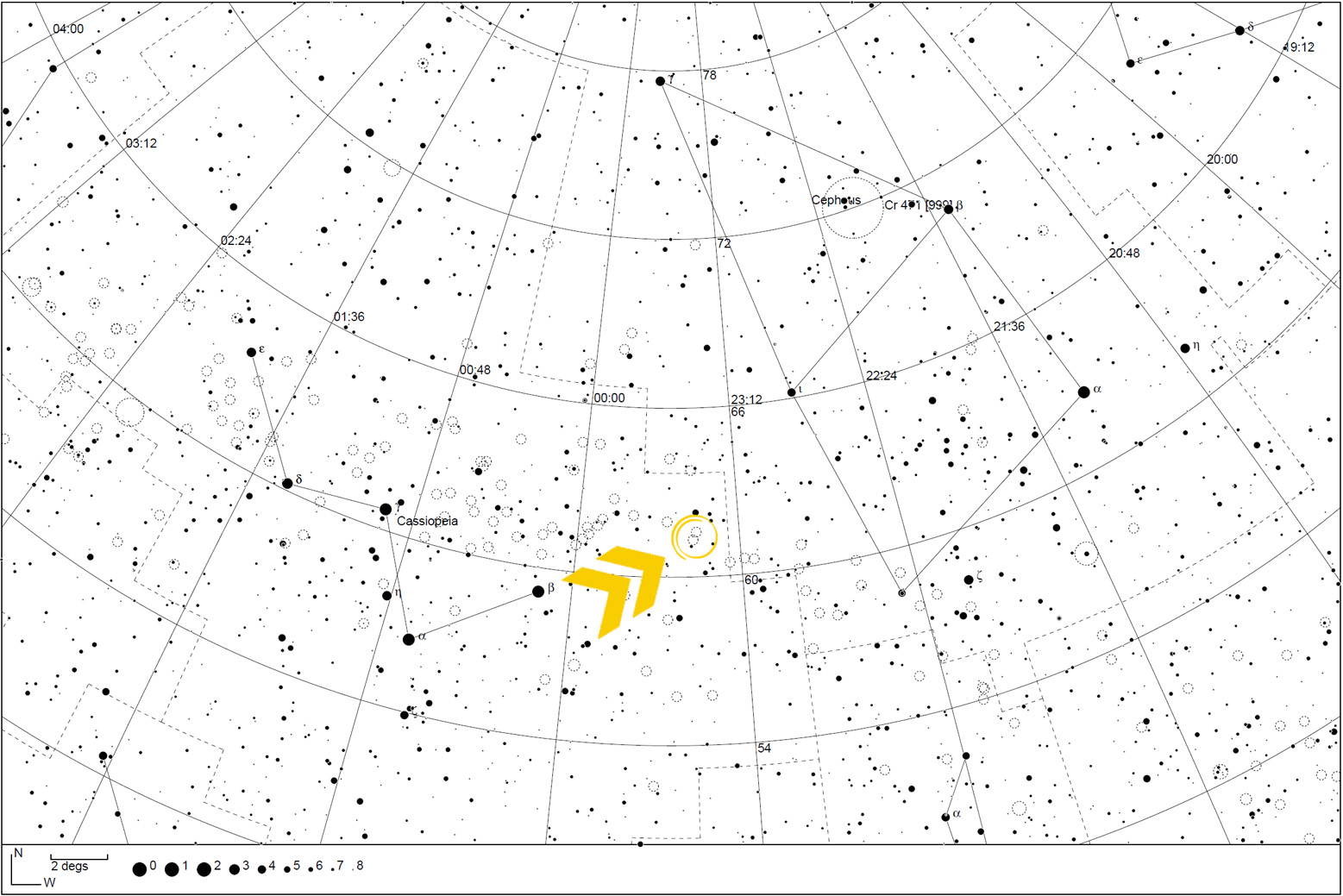
I’m sharing 1-1 raw frame of the finished photo for download and inspection. Images taken on the same night, in 4 different skies. Since I’ll be photographing the Bubble Nebula with this pair in the following (but I won’t show the filter there, I’ll just share the images), I’m uploading the raw pair related to the subject here – again, just to facilitate comparison.

L-Synergy – NGC 896
L-Extreme – NGC 896

L-Synergy – NGC 7635

L-Extreme – NGC 7635
The equipment used for the test images is the same for both pairs of images. 400/1820 DIY Newtonian telescope, ZWO ASI 2600MC Pro camera with APM 1.5x coma corrector. 480 second exposure, gain 100, cooled to -5 degrees.
